
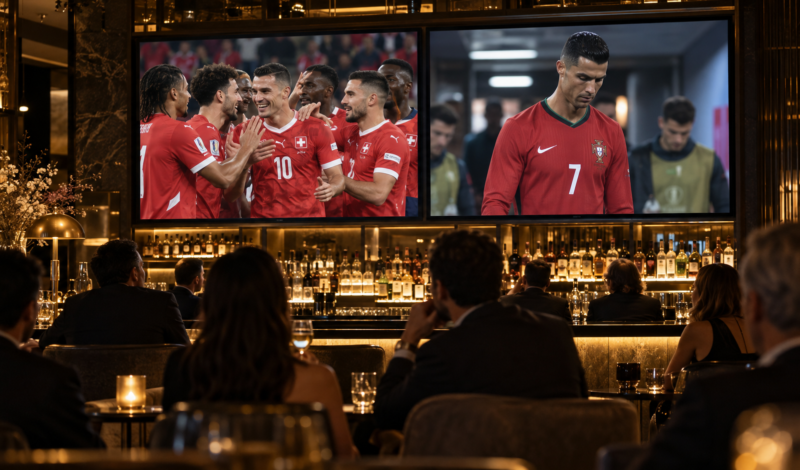

Four Wins for Switzerland, Uncertainty for Ronaldo:
A Changing Moment in European Football
Switzerland’s impressive start and the debate surrounding Cristiano Ronaldo illustrate two very different aspects of international football.
1. THE DEVELOPMENT
Switzerland has made an impressive start to its 2026/27 UEFA Nations League campaign.
Four matches, four victories.
The national side opened with a 3–0 win away to North Macedonia on 26 September, followed by another 3–0 victory in Scotland three days later.
A 2–1 home victory against Slovenia on 3 October was followed by a further 3–0 success against North Macedonia on 6 October.
The results leave Switzerland with twelve points from twelve available in League B Group 1.
Portugal’s campaign has also produced positive results, but its recent performances have been overshadowed by uncertainty surrounding Cristiano Ronaldo.
The 41-year-old forward’s departure from the national team camp has generated significant debate about his relationship with the coaching staff and his future international role.
2. THE PRIVATE WEALTH CONTEXT
International football occupies an unusual position within the wider sporting economy.
It combines national identity, commercial value and the careers of players whose individual profiles may extend far beyond the game.
Switzerland’s recent performances illustrate the importance of collective organisation.
Four consecutive victories reflect not merely the contribution of individual players but the effectiveness of a team functioning together.
Portugal’s situation presents a different question.
How should an organisation manage the transition from an exceptional individual whose achievements have defined an era?
Ronaldo’s career has been extraordinary.
His influence on football, commercial sponsorship and the global profile of Portuguese sport is undeniable.
However, sporting organisations must continuously balance individual status with collective objectives.
3. WHY THIS MATTERS FOR CAPITAL
The international football economy depends partly on the reputations of national teams and their leading players.
Successful international campaigns generate commercial exposure and can increase the visibility of the national game.
Individual stars also possess significant commercial influence.
Ronaldo represents one of the most recognisable personal brands in global sport.
His career has demonstrated the commercial possibilities available to elite athletes through sponsorship, media exposure and personal business interests.
Yet the value of a national team cannot depend indefinitely on one individual.
The challenge is to preserve the institutional strength of the organisation while allowing new generations to develop.
4. WHAT WE ARE WATCHING NEXT
Switzerland’s next Nations League fixtures are scheduled against Slovenia on 13 November and Scotland on 16 November.
Having won its first four matches, the team is well positioned, although qualification and final group outcomes remain dependent on the remaining fixtures.
Portugal’s immediate priority is to maintain its sporting momentum.
The longer-term question concerns Ronaldo’s international future.
His extraordinary career merits respect, but the precise nature of his future involvement remains uncertain.
Statements, selections and performances over the coming weeks will provide a clearer indication of the direction Portugal intends to take.
5. HOW PROFESSIONAL CAPITAL IS RESPONDING
Major sporting organisations face increasing pressure to balance short-term performance with long-term commercial and institutional planning.
National teams are different from clubs because they cannot buy players to address every weakness.
They must develop talent through domestic systems and manage available generations effectively.
That makes continuity particularly important.
Switzerland’s current results suggest the benefits of collective consistency.
Portugal’s debate illustrates the difficulty of managing succession when one individual has achieved exceptional global recognition.
In both cases, leadership and clarity of responsibility matter.
6. THE PRIVATE BANKING PERSPECTIVE
Elite professional sport also creates significant personal financial responsibilities for successful athletes.
International careers may involve income, investments, commercial rights and personal residences across several jurisdictions.
For a player whose career spans decades, managing the transition towards retirement can be as important financially as the period of peak earnings.
Banking relationships, tax residence, asset protection and long-term investment structures require coordination.
Commercial interests may continue well beyond the end of a sporting career.
Ronaldo is a particularly visible example of how an athlete’s professional identity can evolve into a global commercial platform.
The underlying principles are relevant to other successful international sports professionals, even when their financial circumstances are very different.
7. IMPLICATIONS FOR INTERNATIONAL CLIENTS
Sporting careers demonstrate how quickly international circumstances can change.
Transfers, contracts, sponsorship relationships and retirement can affect residence, income and asset ownership.
Where wealth has accumulated across several jurisdictions, effective financial organisation becomes particularly important.
For athletes and their families, the objective should be to create continuity beyond active competition.
Professional success can generate substantial capital.
Preserving it requires a different set of disciplines.
8. THE PRIVATE OFFICE VIEW
Switzerland’s four victories provide a compelling example of collective execution.
Portugal’s debate around Cristiano Ronaldo raises equally interesting questions concerning leadership, transition and institutional continuity.
Both developments extend beyond the immediate results.
They demonstrate how successful organisations must balance established achievements with the demands of the future.
At Sutterson Reed, we recognise the importance of those principles across business, private wealth and international sport.
Talent can create extraordinary opportunities.
The structure around it determines how effectively those opportunities endure.
Greatness may be achieved individually. Lasting success requires an organisation capable of moving forward.
